
Carney’s Love-Affair with China: A Dangerous Path for Canada, How We Got Here, and What If the U.S. Didn’t Clap Back?


With the help of AI to ensure accuracy
Favoring centralized control and elite priorities over democratic accountability and national interest
Prime Minister Mark Carney’s deepening embrace of China — most visibly through the January 2026 “new strategic partnership” announced during his Beijing visit — marks a high-risk pivot away from Canada’s longstanding North American alliance with the United States. This shift, often justified as pragmatic realism in a fractured global order, risks exposing Canada to Beijing’s economic coercion, security vulnerabilities, and influence operations while eroding sovereignty and freedoms at home. Carney’s pre-politics role at Brookfield Asset Management (where the firm amassed billions in China-linked investments under his watch) fuels suspicions of indirect personal or network benefits from policies that favor Chinese supply chains, yuan-based trade, and green tech cooperation. His advisory influence during the Trudeau era, including support for the Emergencies Act crackdown on the Freedom Convoy, adds to perceptions of a pattern favoring centralized control and elite priorities over democratic accountability and national interest.
The timeline below details how we arrived at this point, weaving in public actions, Brookfield dealings, ethics concerns, domestic maneuvers, and the specific dangers of Chinese EVs (including “spy cars” concerns echoed by Doug Ford and U.S. officials). Recent headlines and reports highlight ongoing human rights abuses in China — particularly in Xinjiang (Uyghur forced labor and mass detention), Tibet (cultural suppression), and Hong Kong (dismantling of civil liberties) — which Carney’s “predictability” praise with Beijing appears to downplay.
2020–2022: Unelected Influence as Trudeau’s Advisor — Freedom Convoy Crackdown
How it started as we know it (publicly)…
Carney served as an informal, unpaid economic advisor to Justin Trudeau starting around 2020. In February 2022, amid the Freedom Convoy protests against COVID mandates, he published a Globe and Mail op-ed titled “It’s time to end the sedition in Ottawa by enforcing the law and following the money.” He described convoy donations as “funding sedition,” urged authorities to choke off financing, and called for decisive measures to end what he called a “manufactured crisis.”
This rhetoric closely preceded — and arguably helped justify — the Trudeau government’s invocation of the Emergencies Act days later, which authorized warrantless freezing of bank accounts belonging to suspected supporters and donors. The Federal Court ruled the invocation unconstitutional in 2024 (upheld unanimously by the Federal Court of Appeal in January 2026), finding violations of Charter rights to freedom of expression and protection against unreasonable search and seizure. Critics contend Carney’s high-profile intervention contributed to normalizing this overreach, revealing a willingness to prioritize state power over peaceful dissent and individual rights.
Photo credit: Business Insider/Getty Images
2020–2025: Brookfield’s Extensive China Investments Under Carney’s Leadership
Carney joined Brookfield Asset Management in August 2020 as vice-chair and head of ESG and impact fund investing (later chair and head of transition investing), focusing on sustainability and renewables. During his tenure, Brookfield significantly expanded its China footprint, holding over $3 billion in politically sensitive assets tied to state-linked entities. Major examples include:
- A $750 million stake in high-end Shanghai commercial property (China Xintiandi) since 2013, partnered with a Hong Kong tycoon affiliated with the Chinese People’s Political Consultative Conference (CPPCC), which the CIA identifies as a core United Front influence apparatus.
- A 2019 Shanghai land purchase valued at approximately $2 billion at the peak of China’s real estate bubble.
- Hundreds of millions in renewable energy assets acquired through TerraForm Global in 2017.
- A $100 million joint venture with GLP for solar projects in 2018.
- In late 2024/early 2025 (under Carney’s oversight), Brookfield secured $250–276 million in refinancing loans from the state-controlled Bank of China for Shanghai holdings amid China’s property market crash and soaring vacancies.
These deals often involved partners connected to CCP-linked networks, and Carney reportedly met Xi Jinping and other officials during key periods. Meanwhile, Brookfield’s Global Transition Funds (which Carney helped structure and lead) grew to manage billions in assets focused on decarbonization — sectors that overlap with China’s dominance in EV batteries, solar, and green supply chains. This timing raises serious questions: Policies Carney later advanced as PM (e.g., importing Chinese EVs, yuan swaps, clean tech cooperation) could indirectly enhance the value of these legacy investments or carried interest payouts.

Photo credit: The Wall Street Journal
Late 2024–Early 2025: Freeland Resignation, Trudeau Exit, and Unelected PM Ascent
In December 2024, Chrystia Freeland resigned as Finance Minister and Deputy PM, publicly criticizing “costly political gimmicks” and fiscal decisions amid looming Trump tariff threats. Reports indicate Trudeau had planned to replace her with Carney in a key economic role, prompting Freeland’s abrupt exit and sparking a Liberal caucus revolt that led to Trudeau’s resignation announcement in January 2025. Carney then won the Liberal leadership and was sworn in as PM in March 2025 — without ever having held elected office — after the party revoked incumbent MP Chandra Arya’s nomination in the Nepean riding to clear his path.
While no concrete evidence proves direct “collusion” between Carney and Freeland to orchestrate Trudeau’s ouster, the sequence — Freeland’s dramatic rebuke followed by Trudeau’s departure and Carney’s immediate elevation — has fueled speculation among critics about coordinated elite maneuvering to maintain continuity on globalist priorities, including China engagement and multipolar hedging.
Photo credit: Los Angeles Times

April 2025: Snap Election Amid U.S. Tensions — “New World Order” Rhetoric
Alliances with Nuclear powers against the U.S.A – WHAT?!
Shortly after taking office, Carney called a snap election for April 28, 2025, positioning it as essential for a “strong mandate” to confront Trump-era tariffs and annexation rhetoric. He declared the longstanding U.S.-Canada relationship “over,” rallying with an “elbows up” defiant stance.
In election debates, Carney referenced a “new world order” characterized by great powers pursuing self-interest without constraints, urging middle powers like Canada to form coalitions for survival — language that echoed his later Davos speech and alarmed observers about prioritizing multilateralism over bilateral U.S. ties. Meanwhile, Freeland (in her brief leadership context around early 2025) suggested Canada seek security guarantees from nuclear-armed middle powers like Britain and France — a statement interpreted by critics as openly hedging against potential U.S. unreliability. Let me say that again – they toyed (still are) with the idea to align with middle allies that have NUCLEAR POWERS to go AGAINST the United States. This was/is extreme rhetoric which unfortunately went barely noticed as our press are compromised. If Pierre would have said that…
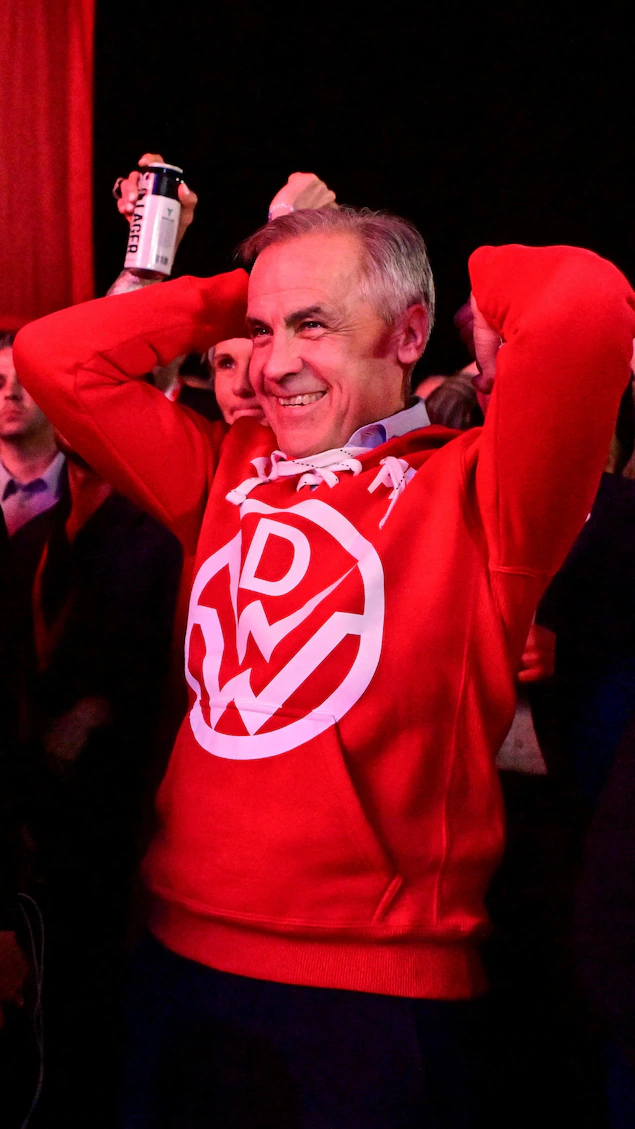
Late 2025: Floor-Crossings to Secure Majority-Like Power
Following the minority outcome of the April 2025 election, defections from opposition ranks began eroding Conservative strength. In December 2025, Ontario MP Michael Ma (Markham-Unionville) crossed the floor to join the Liberals, publicly praising Carney’s “practical” leadership for “unity and decisive action.” Carney welcomed him onstage at the Liberal holiday caucus party, touting the “big, broad, and growing Liberal tent” — a move that left the Liberals just one seat shy of a majority.
Ma’s defection and rapid elevation drew particular scrutiny because his riding had been tainted by foreign interference controversies (e.g., 2025 scandals involving China-linked vote suppression claims and comments from a former Liberal candidate about turning rivals over to Beijing authorities). Critics viewed the floor-crossing as circumventing the electorate’s will through backroom incentives rather than earning a mandate at the ballot box.
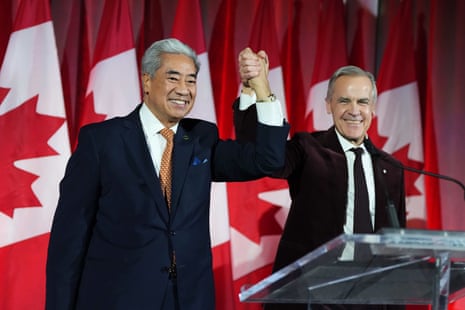
Photo credit: The Guardian/Canadian Press/Shutterstock
January 2026: Beijing Partnership — The Fallacy of touting China as “More Predictable” Than U.S.
Carney’s January 14–17 visit to Beijing — the first by a Canadian prime minister in years — produced a “new strategic partnership” with Xi Jinping. Key elements included allowing up to 49,000 Chinese electric vehicles into Canada at a reduced 6.1% tariff (down from prior frictions), renewing a 200 billion yuan/CAD currency swap to facilitate non-USD trade, and commitments to joint working groups on energy, agri-food, clean technology, lumber, and tourism. Carney described the relationship as “more predictable” than ties with the U.S. amid tariff pressures.
Notably, recent floor-crosser Michael Ma joined the delegation alongside cabinet ministers like Foreign Affairs Minister Anita Anand and Industry Minister Mélanie Joly. Ma’s Mandarin/Cantonese fluency and vice-chair role on the Canada-China Legislative Committee were cited as practical assets, but critics saw his inclusion so soon after defecting as a clear reward for crossing the floor — potentially priming him for promotion while raising red flags about influence in a riding already shadowed by PRC interference concerns.
Meanwhile, Brookfield’s ongoing yuan-financed green technology partnerships and renewables exposure in Asia aligned suspiciously with the policy emphasis on Chinese EV supply chains and clean tech collaboration.
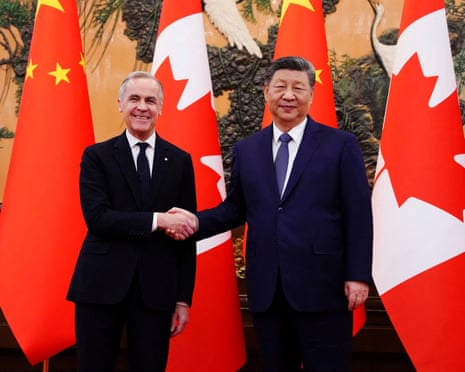
Photo credit: The Guardian/Reuters
Dangers of Chinese EVs: “Spy Cars” and Remote Kill Switch Concerns
The influx of Chinese EVs under the partnership has drawn sharp warnings from Canadian provincial leaders, U.S. officials, and cybersecurity experts. Ontario Premier Doug Ford repeatedly labeled them “subsidized spy cars” capable of listening to phone calls, collecting data for Beijing, or even serving as “roving surveillance operations.” He argued the deal damages Ontario’s auto sector and opens doors to espionage, with EVs potentially transmitting sensitive information from drivers or near military sites.
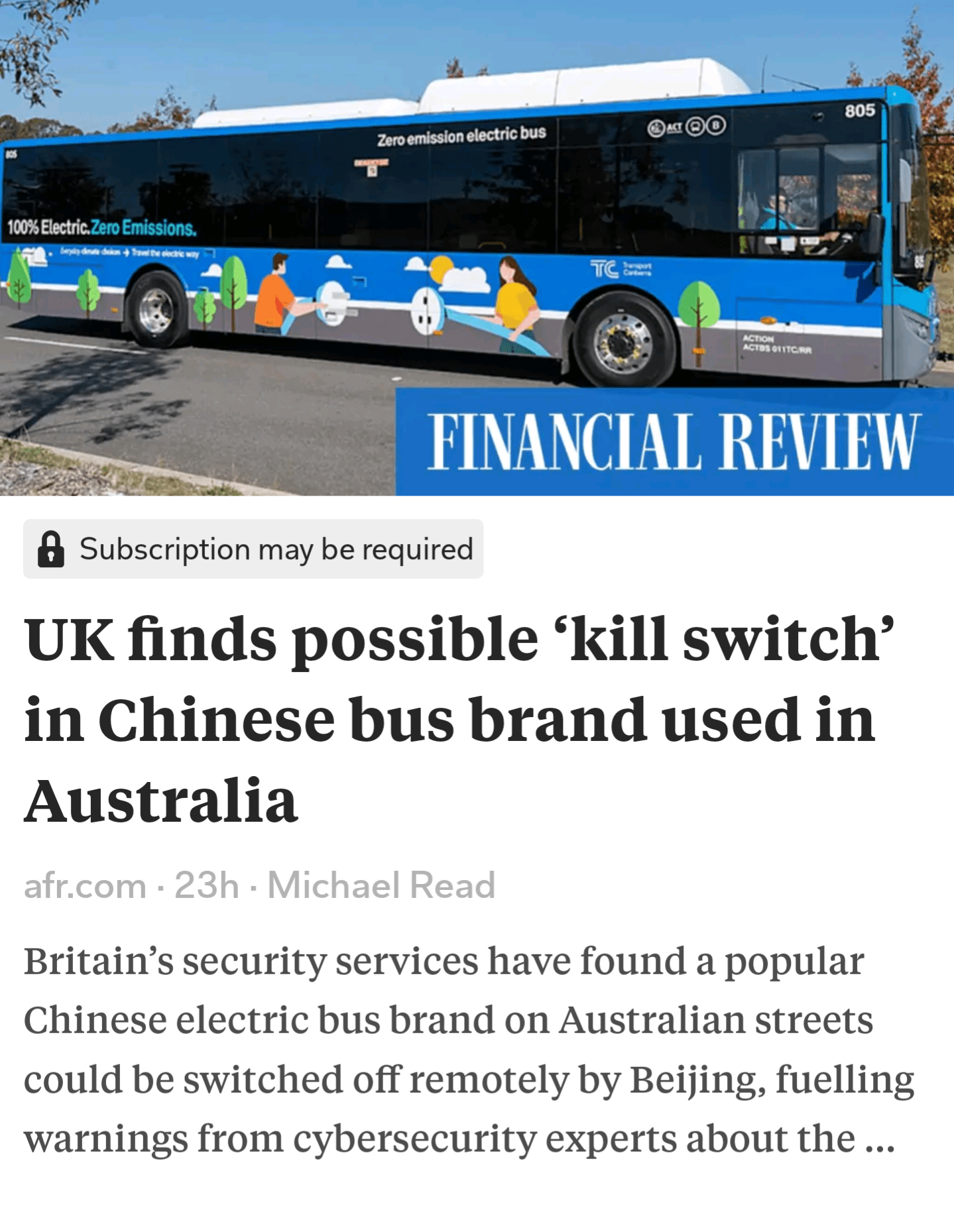
U.S. voices echoed these fears: Officials like Commerce Secretary Howard Lutnick and others highlighted cybersecurity risks, with reports of Chinese vehicles as “computers on wheels” that could siphon data or be remotely disabled in crises. In Australia, investigations into Yutong electric buses (used in public fleets) revealed potential “kill switches” — remote shutdown capabilities via manufacturer telematics or software, as confirmed by UK and Norwegian tests in late 2025/early 2026. While Australian buses differ slightly, the vulnerability prompted fresh probes and telematics disabling as precaution — raising alarms about foreign control over critical transport infrastructure.
These concerns are amplified by broader human rights headlines on China: Ongoing crimes against humanity in Xinjiang (Uyghur mass detention, forced labor, cultural erasure per 2025 Human Rights Watch and UN reports), repression in Tibet (mandatory boarding schools, surveillance), and Hong Kong’s dismantled civil liberties under national security laws. Carney’s “predictability” framing with Beijing appears to sideline these abuses.
Photo credit: MSN/Toronto Star

Photo credit: ABC News
January 2026: Davos “Rupture” Speech — Disingenuous
Just days after Beijing, Carney delivered his January 20 special address at Davos, declaring the world “in the midst of a rupture, not a transition.” He described the post-WWII rules-based international order as a “pleasant fiction” — marked by hypocritical enforcement, asymmetric trade rules, and selective application of international law — now shattered by unconstrained great-power self-interest. Middle powers like Canada, he argued, must form flexible “variable geometry” coalitions for strategic autonomy, drop nostalgia for the old system, and adapt pragmatically: “You cannot live within the lie of mutual benefit through integration when integration becomes the source of your subordination.”
The speech earned a standing ovation from Davos elites and praise for its “clear-eyed realism” in the face of Trump-era disruptions. Full transcripts highlight nods to enduring values like human rights and sovereignty alongside calls for plurilateral cooperation.
From a scrutinized perspective, however, the framing appears disingenuous. As a former architect and defender of the very financial and trade architecture he now dismisses (Bank of Canada Governor, Bank of England Governor, Financial Stability Board chair), Carney benefited enormously from its stability and open markets. He levels sharp criticism at U.S. “coercion” and hegemony while applying far softer scrutiny to China’s economic pressure tactics, intellectual property theft, and territorial aggression. Praising “predictability” with Xi in Beijing immediately before decrying the old order’s lies creates a glaring contradiction — one that accelerates de-dollarization (echoing his 2019 Jackson Hole proposal for a synthetic hegemonic currency or yuan rival to the USD) while deepening ties to an authoritarian power.
Howard Lutnick dismissed the rupture narrative as “political noise,” warning that such China deals could jeopardize CUSMA renegotiations and undermine North American unity.

Photo credit: Foreign Policy/Getty Images
Nice to see Carney quoting Havel in his Davos speech, but he clearly didn’t finish reading "Living in Truth"—having missed Havel’s most important advice on how to deal with a Communist country.
Guess he was in a hurry to go to China and then on to Davos:
Living in Rush. pic.twitter.com/sBlAdw0kVq— Henry Gao (@henrysgao) January 21, 2026
Ongoing: TikTok Reprieve and Media Temper
Recently, Canada quietly dropped its TikTok wind-down order (shifting to an ongoing national security review under the Investment Canada Act without forced divestiture) — a softening on Chinese digital influence that contrasts sharply with U.S. measures. In January 2026, a Federal Court shelved a prior closure order for TikTok Technology Canada Inc., sending the matter back for fresh review after the government consented.
As issues may bubble up and questions swirl, remember..
Carney has shown a prickly side in media interactions, particularly when pressed on conflicts: During a March 2025 CBC interview, when Rosemary Barton questioned potential Brookfield ties, he responded with “Look inside yourself, Rosemary,” accusing her of approaching from “a prior of conflict and ill will” — a moment widely criticized as condescending. Similar patterns of interruptions or dismissals toward female journalists have been noted in campaign compilations. Including past accusations of bullying increasing under his watch emerged during his tenure at the Bank of England. Mostly reported by women or diverse persons.
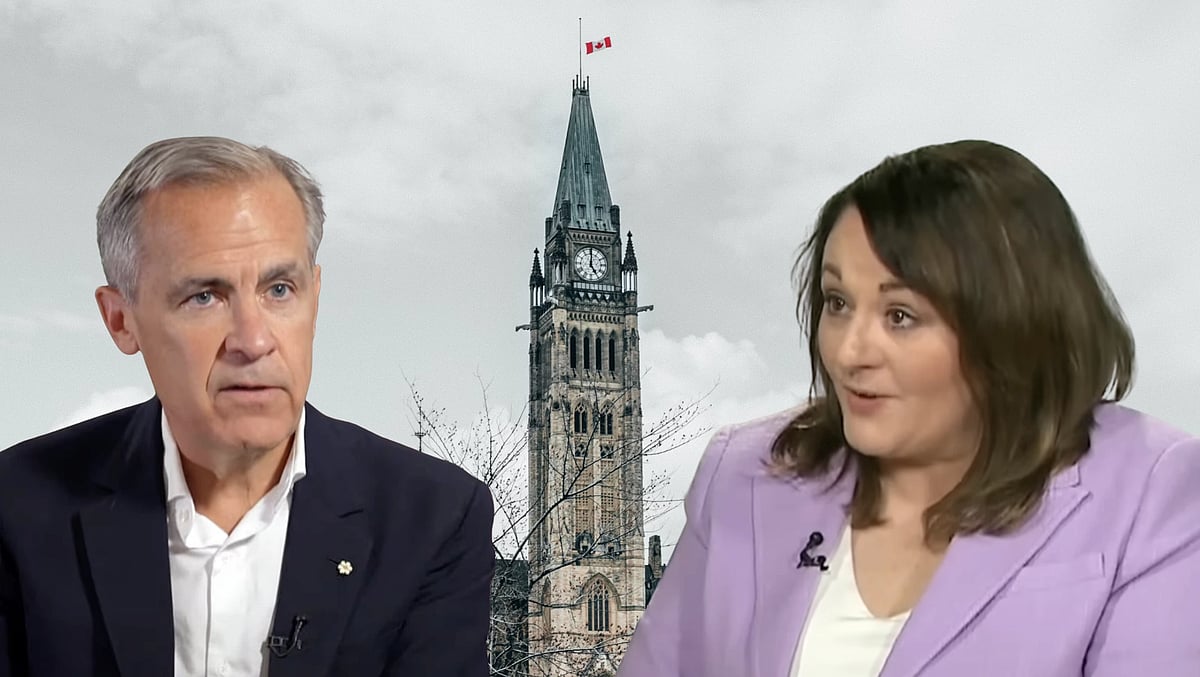
Photo credit: Western Standard
Hypothetical: What if the U.S. Didn’t Clap Back — Dystopian Risks
Without U.S. tariffs, alliance enforcement, or counter-pressure, Carney’s multipolar vision — embracing central bank digital currencies (CBDCs) for “financial inclusion,” digital IDs for government services, and deepening China partnerships — could lead to a more centralized, surveilled society. A digital loonie would enable granular transaction tracking and programmable money (e.g., restricted spending); integrated digital IDs risk privacy breaches and the emergence of soft social credit mechanisms.
He’s already attempting to usher in crackdowns on social media, speech, and gun rights through controversial bills. The revived push for online harms legislation (reviving elements of the former Bill C-63, the Online Harms Act, expected in 2026) aims to regulate platforms for “harmful content” including hate speech and incitement — critics warn it could chill free expression via broad definitions and penalties. On gun rights, Carney’s government has continued or expanded Trudeau-era initiatives like the assault-style firearms buyback and restrictions, with reports of ongoing pressure on lawful owners despite internal Liberal debates calling aspects “stupid” — framing it as public safety but seen by opponents as infringing Charter-protected rights.
Heavy reliance on Chinese supply chains invites economic coercion (as seen in past agricultural tariffs), while unchecked immigration strains resources in towns and cities. Freedoms could erode subtly — speech chilled through disinformation laws and online harms rules, dissent penalized algorithmically — creating a hybrid dystopia blending China’s surveillance model with Western bureaucratic overreach. Canada risks becoming a compliant middle power, trading sovereignty for “predictability” with authoritarian partners at the expense of North American security and prosperity.
Europe’s experience offers a stark preview: Heavy reliance on green tech has led to sky-high energy costs, industrial decline, and economic stagnation in countries like Germany (over $500 billion spent on Energiewende with persistent coal dependence and deindustrialization). Migration policies have correlated with rises in reported sexual violence and crime in parts of Europe (EU sexual offenses up 79% from 2013–2023, rape cases doubled per police data). Trump has long warned of these failures — calling Europe “unrecognizable” due to over-regulation, mass migration, and green energy missteps — and recent Davos 2026 admissions from German Chancellor Friedrich Merz (labeling EU the “world champion of over-regulation and zero growth,” nuclear exit a “strategic mistake”) vindicate him. Experts warn continued mismanagement could lead to systemic collapse in 20 years, exactly as Trump predicted — without U.S. “clap back” pressure (tariffs, Greenland rhetoric), these truths might never surface, leaving allies like Canada vulnerable to similar downfall (Venezuela-style dependency and decline).
German Chancellor Merz admits EU over-regulation and zero-growth failures at Davos 2026
— Raindrops on Lilies 🌸 (@RainDropsLily) January 22, 2026
Closing: Lutnick’s Warning — The Wrong Path
U.S. Commerce Secretary Howard Lutnick emphasized that U.S.-Canada relations remain “perfectly fine” with mutual benefits — no irreparable rupture required. From a commonsense viewpoint, Carney’s love-affair with China, his role in justifying the Convoy crackdown, disingenuous Davos framing, Brookfield shadows, and elite maneuvering endanger Canada: alienating our primary ally, potentially enriching global networks, and weakening domestic freedoms and economic resilience. This path appears dangerous — Canada deserves leaders who put national sovereignty and everyday citizens first, not Davos applause or Beijing predictability.
What do you make of Howard Lutnick's comments? pic.twitter.com/6Au6aXaYSo
— Canada Proud (@WeAreCanProud) January 22, 2026
Full interview here.
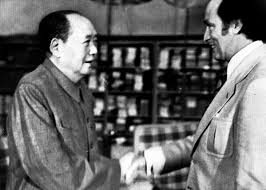 Canada has mostly elected Liberals into government, but since Trudeau Senior, there was a noteable shift as he cozied up to China’s Mao Zedong, a brutal communist dicator that under his rule, millions perished. That shift has only accelerated to what we see today. CCP Fever -> Activism -> Radicalization, that has blown up to something most of us cannot comprehend. Yet there is still a very large and vocal part of Canada that has sailed along, content in this mess and refuses to let go of liberal ideology of yesteryear. As Canada struggles and the youth are battered with nightmare wokeism, crippling finances they have been quicker to wake as they flock to the Conservatives – but the boomers cling on – as 3 provinces are fracturing – while Carney and his ilk blow up U.S. trade negotiations, which I argue, on purpose – so they can usher in the CCP’s NEW WORLD ORDER. We have already been battered with Foreign interference, drugs, money laundering, gangs, mass immigration and election interference. Remember this my friends – China is in it for the LONG GAME. How else could you destabilize the West without firing a shot. Fortunately our US neighbours have caught on – but us… We are heading down a very dangerous path, and honestly I’m not sure where it’s headed, but I know for sure – our neighbours will NEVER tolerate China at it’s borders.
Dare I say, any head of our government intent on jeopardizing our security, blowing up trusted relations, fantasizing forming allies with nuclear powers to “protect” against our most powerful and treasured ally – which happens to live right beside us – is to me, treasonous.
Related Posts
It started out as a JOKE, then Canadians, manipulated by govt and media lost their collective minds; rabid, petty, cult-like behaviour ensued: Trump, believe it or not, has held back, yet now there’s a noteable shift… We are in deep trouble!
Canada is only as good as its trade with the US
Buffalo Rising: Should I stay or should I go…
Alberta’s Last Chance: Why a Strong Vote for Real Change Could Finally Get You Heard – Even If You Never Want to Leave Canada